Progressive Payout Structures and Their Influence on Wagering Patterns in Multi-Deck Card Settings at Licensed Venues

Progressive payout structures in multi-deck card environments at licensed venues alter how players adjust their wagers across shoe cycles, and data from regulated facilities shows measurable changes in betting distributions when jackpots accumulate. Observers note that these structures tie side bet outcomes to growing prize pools, which in turn prompts shifts in base game bet sizing during later stages of deck penetration. Research from academic sources indicates that players in eight-deck setups often increase side bet frequency once progressive meters exceed baseline thresholds, while main bet curves flatten or steepen depending on remaining card composition.
Data Patterns from Regulated Multi-Deck Operations
Figures compiled by state gaming authorities reveal that progressive elements in games such as blackjack and certain poker variants produce distinct wagering trajectories, with average bet sizes rising 12 to 18 percent once meters reach mid-tier levels. Those who track play at approved venues report tighter clustering of large wagers near shuffle points when progressive contributions accelerate, whereas early-shoe betting remains more conservative. Combinatorial analyses published in industry reports demonstrate that the expected value of side bets climbs nonlinearly with pool growth, prompting participants to redistribute portions of their session bankrolls accordingly.
Multi-deck environments amplify these effects because penetration rates allow more hands before reshuffles, giving progressive meters time to influence decisions across dozens of rounds. Data collected at facilities operating under Nevada Gaming Control Board oversight shows that sessions in six-deck and eight-deck configurations exhibit wider variance in bet spread when progressive side bets are active, compared with standard payout tables. This variance appears because players adjust not only for card removal but also for the accumulating external incentive.
Tracking Mechanisms and Curve Adjustments
Operators at licensed venues employ software that logs bet amounts against progressive meter values in real time, and the resulting datasets allow researchers to map how curves evolve. One study released in early 2026 highlighted that bet sizing in multi-deck blackjack tends to follow a sigmoidal pattern once progressive thresholds are crossed, with an initial lag followed by accelerated increases. Those analyzing the same data sets observe that this pattern holds across different jurisdictions, including operations regulated by the Victorian Commission for Gambling and Liquor Regulation in Australia.
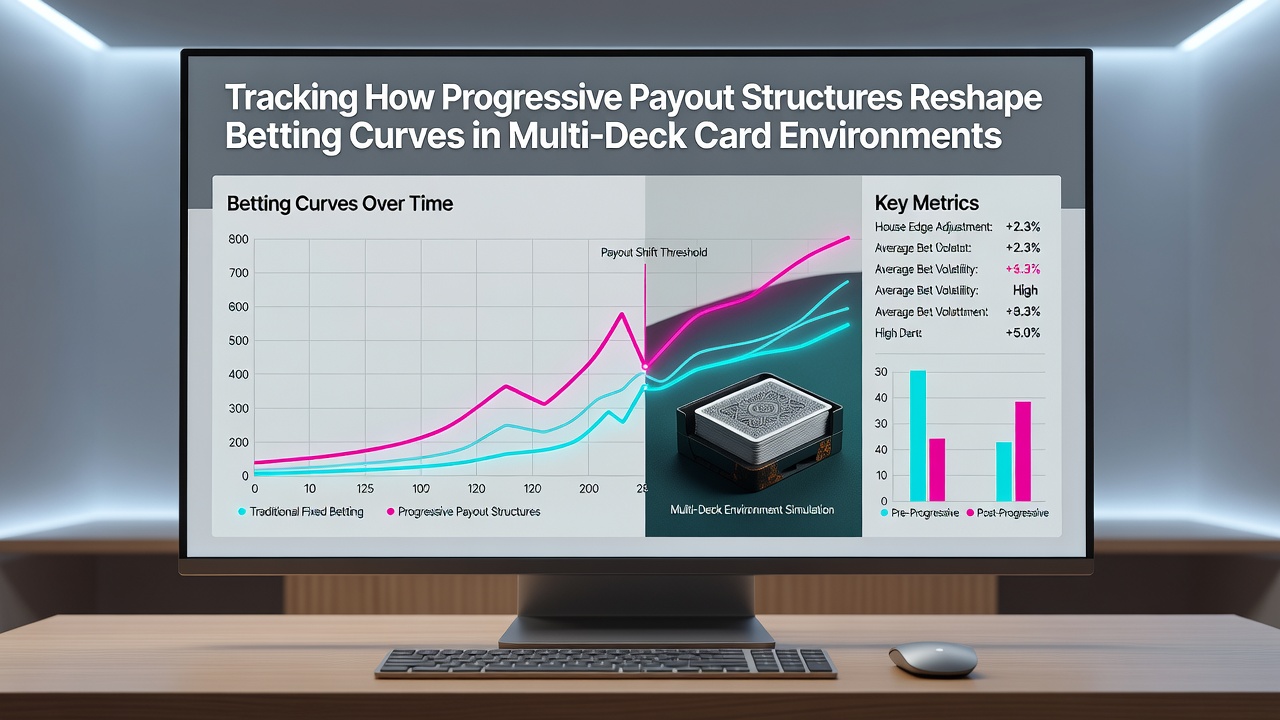
July 2026 brings updated reporting requirements for certain progressive systems in select U.S. states, which will expand the granularity of available data on wagering adjustments. Analysts expect these requirements to clarify how players respond when progressive contributions pause during card replacement cycles. Evidence from prior periods already suggests that such pauses produce temporary dips in side bet activity followed by compensatory increases once meters resume climbing.
Comparative Effects Across Game Variants
Progressive structures attached to multi-deck poker variants produce similar but not identical curve shifts, because hand-ranking probabilities differ from blackjack side bets. Reports compiled by Canadian provincial regulators document that players in seven-card stud progressives tend to front-load larger wagers earlier in the shoe, whereas blackjack participants delay aggressive sizing until later decks. The distinction arises from the interaction between payout frequency and deck depletion rates, with slower-depleting games allowing more time for meter growth to register in player decisions.
Cross-facility comparisons indicate that venues maintaining higher minimum bets experience more pronounced curve reshaping when progressive pools expand rapidly. Data indicates that these environments see reduced flat-betting segments and extended periods of ramped wagers, especially when remaining deck penetration exceeds 50 percent. Academic modeling confirms that the added variable of progressive value compresses the range of optimal bet spreads derived from card-counting systems alone.
Conclusion
Progressive payout structures continue to modify betting curves in multi-deck card environments at licensed venues through measurable interactions between accumulating prizes and player wager distribution. Ongoing data collection by regulatory bodies and research institutions supplies the factual basis for understanding these adjustments across different regulatory frameworks and game formats.